Tuesday, August 14, 2012

Down is Way More Fun


Standing on top of one of the seven summits is a goal sought after by people the world around. At 20,320 feet, Denali, aka Mt McKinley, is North America’s tallest mountain. Some claim that it is more difficult to climb than Everest. This is likely due to the heavy packs, deep snow, lack of Sherpa support, and arctic temps. Since I have not yet climbed Everest I cant confirm that claim, but I do know that climbing Denali is very difficult.

Janelle and I “bumped” from the Tokositna Glacier directly over to the Kahiltna Glacier after our successful climb of Mt Huntington via the Harvard Route. That climb took 3 days, followed by 4 days of waiting on clear weather to fly, so we still smelled relatively fresh, at least by Denali standards.
Our 4-day bad weather nap on the Tok left very rested, and a little antsy to get going. Two hours after landing at the Kahiltna basecamp we were moving our huge sleds to Camp One, located 5.5 miles away at 7,800 feet.
 Skiing makes the experience of hauling heavy loads way more enjoyable. Skinning up the gigantic Kahiltna Glacier by the light of the midnight sun was amazing. It was almost beautiful enough to take our minds off the collective 300lbs of equipment trying very hard to crush us. Three hours of brut hauling later we arrived at camp.

The next morning we carried half our kit up Ski Hill and beyond, to the 11K’ camp. This took 5 hours. After burying those supplies three feet under the snow, and GPS waypointing its location for easy retrieval, we skied back down to 7,800’ camp...in 10 mins!
Two days later we were ready to schlep our loads from the 11K’ camp to Windy Corner. This requires going up Motorcycle and Squirrel Hills. Motorcycle Hill would become the site of the fatal avalanche that took four Japanese climbers’ lives while they descended this slope two weeks later. Trying to haul a sled and a pack up the hill proved to be impossible, and extremely frustrating, with the two feet of fresh snow that had fallen the previous day.

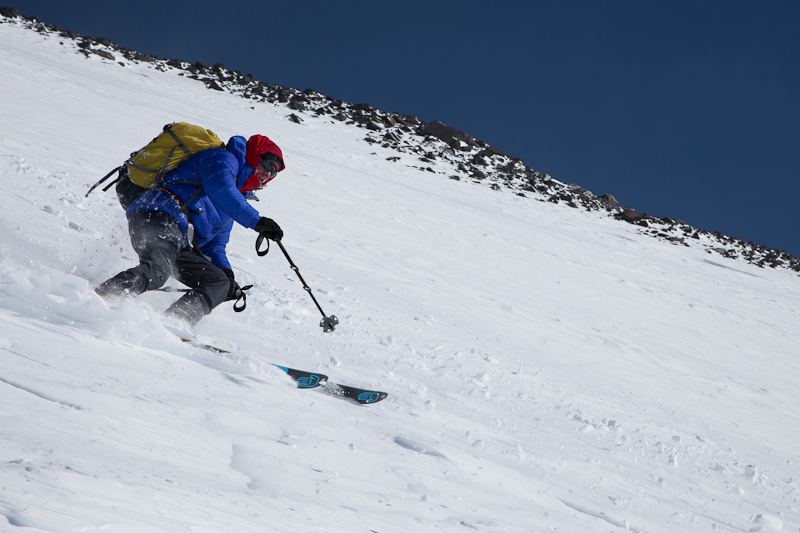
Deep fresh snow makes for horrible climbing and great skiing, so we decided to ditch the sleds, and skin to the top of both hills carrying only our packs. Then come back and get the rest of the load later. The best part is that we got to ski down in between loads. All told we climbed and skied this part of the mountain four times. The “quad-carry” is definitely the way to go…with deep snow and fun skis.

On day 5 we arrived at 14 Camp (located at 14,200 feet). This high altitude gypsy tent city is quite the anomaly.  There are roughly 150 people from all over the globe, congregating in this barren beautiful white frozen patch of snow. Everyone has fortified their plot of snow with large ice block walls. These walls help prevent the neighbor’s dog from crapping on your lawn. They also serve as wind blocks, so your tent doesn’t break during the huge storms that sweep the area on a regular basis.

It’s easy to spot the civil engi-nerds among Camp 14’s tent city, as their walls are constructed perfectly, with ice blocks fitting together to create airtight fortification. Once our little campsite was constructed we rested. About that time the routine of living on Denali set in hard and fast. The routine looks something like this.

9:00AM: Bladder screams you awake. Answer the call, using the brimming pee bottle. Still below freezing, so its back in the sleeping bag.
10:45: Cold water droplets hit face every 30 to 60 seconds, caused by the melting hoarfrost that built up on the inside of the tent.
10:50: Get fed up from the Chinese water torture. Put on a flock of down, go outside.
11:15: Breakfast time: Hot cocoa, pancakes (“bootied” from a group descending), bacon. All cooking done in the kitchen tent, which then becomes the hang out tent.
11:50: Poop in a plastic lined 12-inch tall green plastic can, hoping that a ground blizzard doesn’t pick up and freeze your bareness while squatting over it.
12:00: Hang out in the cook tent, shooting the bull with new friends, talking about the weather, other climbs around the world, and playing the game called, “have you seen that youtube video where…”
2:30PM: Go for a ski tour just outside of camp, sometimes with climbing gear, sometimes without.
5:00: Lunch time: Cheesy Quesadilla, with salami and mustard…add guacamole on special days.
5:30: Walk around camp, meeting those that just arrived.
8:00: Card games in the neighbors cook tent.
10:00: Dinner time: you name it, we ate it.
12:30AM: Feet are now too cold to have fun anymore. Crawl in the tent and watch 2-3 episodes of The Office on the ipad until the screen frosts over.
1:45AM: Still not dark outside, but go to sleep cause that’s what you were suppose to do hours ago.

This rock and roll lifestyle went on for days and days. When the weather was nice we would escape uphill as high as possible to help the acclimatization process. You see, we needed to prepare our bodies for the thin air little chunks at a time. All in preparation to climb the Cassin Ridge as fast as we possibly could.

We went to 16,200’, then again to 15,500’, and finally to 17,800’ before a four day storm locked us down. We felt stronger each day, so logging the time at the higher elevations was working. Our plan was to summit and ski the West Buttress, then rest for 2-3 days prior to going up and over to the Cassin.  Our time was limited, so things had to line up pretty perfectly to make this plan successful.

The morning of July 16th had blue skies and little wind in camp. We packed our bags quickly and headed up the trail that had been beaten in by the 50 climbers in front of us. Since we were on skis, and only had daypacks, we were able to pass everyone before reaching the fixed lines on the headwall that takes you from 15K’ to 16K’.  We put the skis on our packs, strapped on crampons and ascended the wall.

Pack weight is a huge part of moving fast in the mountains. We only carried two types of items, ingestibles and warm clothing. We left the rope behind, which upped the risk factor, but saved 8lbs of weight.

At the 17K’ camp we stopped in a friend’s kitchen tent for a 30 minute break to warm up, lube up, and bundle up. Denali Pass was next.  From there up it is traditionally much much colder. Once we rounded Denali Pass the winds from the North picked up, forcing us to cover all exposed skin. I wanted to switch my sunglasses to goggles, but did not want to take the time needed to get in my pack and put them on. Instead I pulled the drawstrings tight on my hood, faced down wind, and kept plodding along.

We reached the summit around 5:00PM, 7 hours after leaving 14 Camp. It was cold, windy, but relatively clear and amazingly beautiful. Probably the most beautiful part was that we still had the skis on our packs, and they were about to go on our feet! The most novel part about ski mountaineering is that it turns the worst part of climbing into the best part….the descent.

The snow was bulletproof wind-blasted nastiness from the top to about 19K’. It’s the kind of skiing that can make your fillings fall out. We would take three to four turns then have to catch our breath for half a minute. The skiing wasn’t great, but it sure beats walking. The best snow we found on the Phantom Wall, which rises above the 17K’ Camp. Turn after turn we cut up this slope. The air was getting thicker, the views were amazing, and my altimeter watch was having trouble keeping up with the speedy descent.

We stopped briefly at the 17K’ Camp to chat with friends, then walked down the West Buttress to the top of the fixed lines. There was more good snow to be found here, all the way back to our tents. We were tired, but grinning, as we crawled into the bags that night. We had just skied the West Buttress from 14 Camp in a little less than 12 hours.

The following two days we rested. I thought we would bounce back quicker than we did. The two nights after the summit push we packed our bags for the Cassin Ridge. Things were not looking that great, but we were going to be ready if they changed.

That night we set the alarm for 4AM to give us plenty of time to get started on the route. At 3:30AM what felt like a significant earthquake shook us awake. This was followed by serac fall. Scary. Then the wind picked up, and it started snowing. Things were not looking good.
In the mountains it is very easy to make a host of sound excuses not to put your body through more physical and mental exhaustion. I think we had a number of really good ones, which lead us to become part of the statistic stating that 90% of climbers who register to climb the Cassin Ridge never even get on it.  Next year I hope things are different.

Alaska 2012 was a great experience for us. Climbing the Harvard Route on Huntington was the highlight for me, and skiing for the summit of the highest point in North America was a close 2nd.

Thursday, July 5, 2012

Soul Destroying Wallowing Up Mt Huntington

Near the top of Mt Huntington
There is nothing like a big mountain in Alaska to motivate one to train hard throughout the winter. Janelle and I punched the workout clock on a regular basis the last 6 months, making sure that we arrive at Big Snowy in prime time condition. Nordic skiing, backcountry skiing, ice climbing, guiding a Peru expedition to climb 18K’ peaks, and several rando races where all on the menu.

Living in a ski town allowed for easy access to the backcountry, which was our preferred workout routine. Probably the best part about ski touring 8,000 vertical feet in one day somehow turns an entire package of Oreos into a single serving (yet another example of the human mind having the ability to rationalize anything).

We moved out of our rental in Crested Butte at the end of April, back into our van, Lulu, which is now our only home. Are you considered “homeless” if your place of residence gets 20 miles per gallon?

Wanting to be as strong as possible for Alaska, and wanting to have a little bit of summer prior to being locked in the glacier icebox, we headed first to Indian Creek. The climbing there is never ending, and no matter how many times we visit it seems as though we have barely scratched the surface.
Janelle climbing in Indian Creek, UT Super Crack area
Indian Creek was followed by two 50 Classic busts. We tried unsuccessfully to get permission to climb Shiprock, and got frozen off the Petit Grepon in Rocky Mt National Park [we are going to keep knocking on the Najavo Nation door until permission is granted]. Wanting to lick the wounds of my pride by getting to the top of something, anything, we pointed Lulu north to Washington State.
Descending Eldorado Peak, North Cascades, WA
Here we had great success with the two-week high pressure that settled in over the state in May. We completed the Forbidden Ski Tour, skied Eldorado Peak, and skied Mt. Shuksan. Come to find out that both of these ski descents are in Davenport’s book, “Fifty Classic Ski Descents”….the next project maybe?! Both descents are super worthy.
Jon Swain ripping it down the summit coulior on Mt Shuksan, WA
It was then time to make our final preparations for Alaska. Stuffing four duffle bags, each with 50 lbs worth of down products, sharp metal, and tons of camping gear, is quite a task. We did all this at Golden Gardens Park in Seattle, which borders the Pacific on a busy Saturday. I am proud to say that we made even the most seasoned Seattleite turn their head and stare, wondering what we were doing.

It’s a quick flight up to Anchorage where our good friend Bob Lohr picked us up.  This is the third year in a row he and his wife have extended their hospitality, and their Costco card, to us. With a packed SUV we headed further north to spend time with Janelle’s maid of honor, her husband, and their three kids. Any curiosity the Seattleites had for what all our equipment was for what dwarfed by the amazing curiosity of 3-year-old Jeremiah and his little sister.
“Watts dis?”
“Those are skis, for going fast on snow.”
“Watts dis?”
“That’s an ice tool….oh, lets play with something else.”
“Watts dis?”
“That’s a ski pole, its for helping keep your balance.”
“Why?”
“umm….I don’t know how to answer that question.”

The thriving metropolis of Talkeetna (population 876) was full of tourists, and we were happy to add to that number. Weather delayed the flight onto the glacier a day, so we got to hang out an extra night, which turned out to be a great way to settle the nerves after all the luggage schlepping.

The morning of May 23rd was nice enough to fly. Amped, we changed out of our street clothes for our techy climbing clothes. The Tokositna Glacier is not nearly as popular as the Kahiltna Glacier, so we were in a plane by ourselves with none other than the owner of Talkeetna Air Taxi, Paul Roderick. He has been flying climbers in and out of the mountains for a long time and really does a great job.

On the glacier there was one one other party of two. We dragged our supplies 100 yards away from them and set up camp. The two other climbers had their sites on the West Face Couloir Route, and gave us a report that one other group had climbed the Harvard prior to their arrival, which was 10 days before now.

Mark climbing the first snow/ice section on Huntington
The following morning we woke at 7AM and were enroute around 8:30. The trail was kicked in to where the two routes diverge. Once on the fresh snow we sunk up to our knees and the progress slowed considerably. Moral was high so we put our heads down and pushed through it to the bergshrund, where we roped up and started simal-climbing. It really is amazing how quickly one can cover ground when not pitching things out. 3.5 hours of deep snow, a little ice climbing, and a lot of knee deep wallowing brought us to the base of the Spiral feature.
More simal climbing
This is the first of several mixed climbing pitches. M5 is the Supertopo rating. I don’t mix climb that much, so I was nervous. This was evident in the amount of cams I brought….many. Ditching the pack, I racked up and was off. There was a lot of snow covering the rock, which had to be removed. I hooked and pulled my way up little by little. Having a fifi hook was nice when things got cruxy. I would fifi into the highest piece, and start excavating snow and ice to get down to rock, hook my tools onto some stupid-tiny granite crystal the size of a pencil eraser, and pull up to the next placement.
Mark starting out on the Spiral section of, M5
The first anchor on the Spiral consisted of three old pitons at a hanging stance. More mixed climbing followed, which opened up into a 65-degree snow slope. The snow was fluffy, so I had to dig a vertical trench to make upward progress. This was both time consuming and exhausting. The heavy snow year covered up most of the fixed belays, so I dug for 20 minutes to expose a crack for an anchor, 195 feet above the last.
Mark aiding the Nose Pitch, C1
The next pitch was the most memorable. We took the farthest left of the three options listed on the topo. The asterisk on this option reads, “not recommended” due to hard mixed climbing on loose rock. This is where the large amount of snow was in our favor. It created an ice ramp on one side of this steep chimney, which I was able to place screws in the whole way up. With my back against one wall and four metal points biting into the ice on the other, I wormed my way up the 120ish foot pitch to a bolted anchor.
Hauling the packs on a frozen anchor
Two more snow wallowing pitches brought us to the Nose, it had been just over 13 hours since leaving basecamp. We were tired. Still more snow shoveling had to be done to make a bivy ledge. For weight savings we opted to just bring our Nemo Transformer Tarp as a shelter, and leave the proper tent behind. Rigging this to the bolts on the rock wall, and draping it over the snow walls Janelle created, was home for the night. It worked pretty well, but several snow spindrifts came in unabated by the tarp. The key to sleeping in this situation is to get really tired first!
Janelle high on Huntington
Unfortunately, the snow continued throughout the night. Not wanting to get avalanched off the mountain we reluctantly turned our sites downhill the next morning. We really dragged our feet making breakfast, as descending what we had just climbed was going to be no easy task. Around 10:30AM a pocket of blue sky passed over us. Shortly thereafter the snow subsided, and we decided to continue upwards. We had four pitches to get to the easy escape of the W. Face Coulior, which is what we descend if need be.
Janelle following the Nose Pitch
The Nose pitch is pure aid climbing. I was happy to have the experience gained by climbing the Nose in Yosemite to apply those skills here. It was straightforward C1 aid climbing up a 95-degree rock wall. Again the fifi hook was clutch. As I pulled over the slight roof my stomach dropped, this new 70-degree rock face was covered with 6 inches of snow and rotten ice. I had to excavate about 40 square feet of snow to get across to the where I hoped a fixed anchor would be waiting. I dug a while and revealed a fixed piton. This was like a treasure hunt. Making my way across this section took forever. I got to the anchor and had to chop at it for a while to extract the slings from three inches of ice. Janelle jugged the pitch, while helping push up the packs that I was hauling.

More trench warfare followed for another 400 steep vertical feet, where the West Face Couloir and Harvard routes merge. Our “trail” below looked like we just installed a half pipe in the side of the mountain. At this junction we were also able to look down the W. Face Couloir, which is thousands of feet of 50-70 degree perfect glacier ice. This would be our exit on the descent.
From here we had to go up 50 feet then down 80 feet, and traverse a scary unprotectable snow slope. The rock face we traversed beneath had no cracks for pro, but we survived.
Janelle 1500' below the top
Nearing the upper snowfield Janelle took the lead and punched a deep trail up and right, hacked through a corniced wind lip, and built an anchor in the rock. I took the lead on one more time consuming pitch which brought us to the point where it was a straight shot to the summit ridge. I was beat. Janelle was not. She unlocked this section, punching the route straight up to the ridge. We simal-climbed the whole way, literally taking one step up and 9/10th of a step back through the powder.

Near the top, we didnt take any "money" shots while on the summit
On the summit ridge it really started snowing, yet it was happy snow. That is to say there was no wind, and the flakes fell slowly to the ground. We pushed along the ridge until right under the final crux, an overhanging 40-foot wall of alpine ice. I dropped my pack, and went for it. It was pretty fun climbing this section, swinging tools on an overhanging ice wall, so close to the top of mountain in Alaska. How often does that happen?

A few hundred feet later we had run out of mountain to climb, it was 10:30PM. The snow had stopped and we had a semi clear view of the surrounding peaks, it was amazing.
Rapping down the West Face Coulior
The descent went smoothly as we were able to find ice for V-threads when we needed it. We rapped right down into the featured called the Cave, where we spent the night. The following morning it took us about four hours to rap down the W. Face Couloir and get back to the tent. The other group left V-threads all the way down the face, which helped greatly.

Back at camp, soaking in the victory
Back at camp we kicked off our boots, sat on as many pads as we could shove under our butts, and indulged in a lot of junk food. Alternating between salty and sweet food until our bellies were tight and happy. #36 was complete, and we slept with smiles on our faces. 

Monday, April 2, 2012

Clyde Minaret in Subwarm Temperatures


Clyde Minaret from the road

We knew that trying to climb an alpine route at 12,000’ in October was risky, but we wanted to squeeze every once of climbing out of the fall before winter locked its grip on the Sierras. Besides, the Clyde Minaret is one of the easiest climbs on the Classic Climbs list so we went for it, even though the forecast was calling for 30% chance of snow/rain.
The hike up to Minaret Lake passed quickly.  One hundred year old ponderosa pines, rushing creeks, and the occasional songbird that was hardy enough to make it through the Sierra winter occupied our minds during the hike. Dark clouds were ripping past the Clyde when we arrived. It made my fingers cold just thinking about touching that damp, 30 degree, shaded rock.

The next morning was cold, so we slept in. Eventually a few blue-sky sucker holes popped through the blanket of grey, which gave us hope and motivation to get out of our warm sleeping bags.

The mountain came in and out of view as we hiked to its base. Neither one of us said much as we crossed the mini snowfield, as we knew this was going to be a cold climb.  Not to say that climbing in the cold is as bad as sitting in city traffic, but we had been hoping that this “easy” classic climb would be warm and sunny as most other Sierra climbs tend to be.

We roped up and started climbing. Following the path of least resistance along the approach ramp, and then up into a huge dihedral. Thankfully we were able to climb the easier parts with gloves on, and still move quickly up the steep face. Occasionally the sun would break through and we would both stop to soak in the warmish rays.

The climbing was pretty good, a few loose rocks here and there, but a good climb nonetheless.  We made it to the top in a few hours, signed the book we found in the bomber metal summit register, and then had to decide how to get back down.

The topo suggested descending a couloir to the south, but we opted for the rappels to the north, as we did not bring crampons for the bulletproof snow we saw in the couloir on the way up. This descent was the highlight for me. We had to figure things out, make a couple of our own anchors, and chimney through the moat at the base, where the snow field pulled away from the rock, leaving a 20 foot tall hallway we had to pass through.

We got back to camp around six and decided to hike out that night, most of which we did under headlamp. It’s pretty nice to hike at night. The miles pass quickly. We made back to Lulu, drove back to Mammoth Lakes, and fell asleep quickly on a side road in the warmth of our nice soft bed in the van.

The Southeast Face of the Clyde Minaret is definitely worth the hike, but I recommend climbing it when the forecasted high is at least 65 degrees, instead of 40!


***To see the video from the experience visit: smileysproject.com ***

Monday, February 13, 2012

Second Half of Half Dome


Expectations are ever present when returning to a previously attempted climb. In 2010 Mark and I tried to finish our climbing season in Yosemite, CA on the picturesque Half Dome. We were unsuccessful. I was tired from a demanding summer full of adventures and planning and was not too thrilled to jump on another climb, but I knew it meant a lot to Mark, so off we went.

To get to the base of the route we scaled up steep rocks slabs.  Followed by even steeper pitches, including hand over hand rope moves, all this while carrying a heavy haul bag. This was on Mark’s back because the shear weight of it was beyond my ability to carry. We thought it would be a good idea to spend the night half way up the route, which meant we had to haul all our equipment up the wall. Four pitches up and many hours later we had not moved very far up the wall. Our bag was getting caught on everything; we were not going to make it to the sleeping ledge at the pace we were going.

So we bailed.
Not a word was spoken the rest of the day.
It was not Mark’s idea to bail.

Like last year, Half Dome was the final climb on our schedule for the year, but we were both ready to finish the climb this time. We had to get up 23 pitches using only 11 hours of daylight. This race would be demanding.

We started climbing at 4am. To save time, we each attached ourselves to a fixed rope with a Petzl Tibloc (a simplified ascending device) to self-belay ourselves. Without a proper belay, we had to be in the mindset that we were basically free soloing the first five pitches. If one of us did  fall the Tibloc would bit on the rope, and arrest the fall (hopefully). It was too scary to trust it, so we climbed like we were not going to fall.

Right off the bat I realized my shoes were too big…. What? I had worn them before several times, so why now were they too big? I started slipping and sliding around in them so I put on my socks to fill the void. It did work but I felt my precision was off.

After we ran out of fixed rope we started to pitch it out and do a little simal-climbing, where both climbers move at the same time.  As the route wondered the quality of the climbing deteriorated. Once we arrived at the chimney pitches the climbing improved again, and it was really exciting and airy climbing. Luckily, I was leading so I didn’t have to carry the larger backpack up the tight squeezes.

There were some interesting pitches as we approached Big Sandy Ledge (which was not as big as expected). Followed by the more demanding Zig-Zag pitches. Mark took off from the ledge placing tiny pieces, and clipping the amazing amounts of fixed gear on route. I followed with amazement knowing this route has been freed. It was now my turn to lead out on the “Thank God Ledge!”

I started out thinking, “I can do this, this is not too bad.” Then the 10 inch ledge narrowed to 8, then 6 inches about the same time the wall pushed out to vertical, and then a little past vertical. I paused, turned around and told Mark I was tired of being scared, but I also knew it would not be any easier to follow. With some angry aggressive words I crawled across the tiny ledge to where it finally got wider, and therefore more secure.

Mark finished the last couple pitches to land us on the top right as the sun set. We did it, we made it up the Regular route on Half Dome in 14 hours! What a summit, and what a great way to finish 2011. We found our way down the in the dark back to the base where our sleeping bags were waiting for us. I had expected better quality of climbing, but I was overall extremely impressed with the rock, the climb, and the entire experience of climbing such an iconic piece of rock.