Showing posts with label denali. Show all posts

Thursday, June 25, 2015

Denali's Cassin Ridge - Classic Climb #45

Janelle takes a break at the Matt's second bivy, 17K'
Denali’s Cassin Ridge is a true American classic. I have been intrigued by this 8000’ (2440m) ridge since hearing about it in 2004. It carves a direct line, up technical terrain, to the summit of North America’s tallest peak…what’s not to love! My wife of 8.5 years and I were back in Alaska for our third attempt.

Attempt #1 June 2012: First, we climbed the Harvard Route on Mt Huntington, and then bumped directly over to Denali. After skiing from the summit (20,320’) via the West Buttress route, and spending a total of 26 days on the glacier we were fried from continuous bad weather and inaccurate forecasts.

Mark wearing his "grumpy pants" after concluding we could not climb the Cassin for the second time.
Attempt #2 July 2013. First, we were successful on the Mooses Tooth’s West Ridge. Then, straight down to Juneau for Mt. Fairweather, a hard-earned success that took 17 days. Then back to the Cassin. We returned to the 14,000' camp, waited, acclimatized, and waited some more. After 10 days of heavy lifting and skiing around we were poised to go. Upon arriving to the access couloir we discovered the route had melted out from record high temps that season. Rocks showered down the access couloir even during the coldest part of the day. Not willing to jump into this firing range, we bailed again, with tails between our legs. Another $4000 blown on flights and permits. The score was Denali 2, Smileys 0.

High camp on the Mt Logan. photo Jed Porter
Last year we directed all finances and time to Mt Logan…and failed. Following that sucky and scary effort, Janelle underwent two hip surgeries, in July and Sept respectively. She had been dealing with ever increasing hip pain over the last two years. The MRI revealed tore labrums in both hips due to overuse. This was the heavy price of competing at the World Cup level in ski mountaineering.  Thankfully, a full recovery was predicted, yet it would take 10 months to achieve. July 2014, Janelle walked into the hospital and came out in a wheelchair. 10 months of PT, icing, constant passive motion machine, tears and frustration, truckloads of support from friends and family, and 10 gallons worth of Colorado Bulldogs brought us to May. A decision had to be made; do we put the hips to the ultimate test by trying the Cassin a third time?

Despite the PT’s conservative recommendation, Janelle was game. She trained like a crazy person for the next 8 weeks.

Alpenglow on Mt Foraker at 3:30AM
Choosing the best strategy to get to the base of the Cassin Ridge is a tough decision. Each option requires time, motivation, and exposure to significant hazards. If you choose to acclimatize on Denali, 99% of climbers (48.6% of all stats are made up on the spot) make the five-day trek up to the 14,000’ camp, hang out for a week, and maybe go to the summit via the W. Buttress. To get to the base of the Cassin from the 14,000’ camp you must climb up to 16,000’ on the West Rib route, and descend to around 11,500’. Daunting? Yes. This style takes around 10-14 days to complete, assuming you are very strong, stoked, and blessed with great weather. 

On our past attempts we tried that style. We hate it. Getting everything to the 14,000’ camp is a huge effort. From there, it takes significant mental fortitude to ignore the bad weather, the wildly inaccurate weather forecasts, the scared naysayer climbers, and stay stoked for the big objective. Often, eager Cassin suitors do not even step foot on the route.

Nothing like a sit start to squeeze out every drop from this route. Photo: Janelle Smiley
It plays out like this. You go to the summit via the West Buttress and return to the 14,000’ camp. Stoke for the Cassin is quickly lost as the forecast “doesn’t look that great.” The smell coming from your nether region is reminiscent of a week old tuna sandwich, left in a hockey bag, that’s been marinated in baby vomit. The call-of-the-shower, French fries, and flush toilets grows louder and louder. Once a group of summitters (noun: person who has stood on a mountain’s highest point) come down and start talking about ice cream, garden salads and adult beverage consumption…you can kiss motivation goodbye.

This style also requires many many days of high pressure. Good weather to get to 14,000’, good weather to acclimatize, good weather to climb the Cassin, good weather to descend, and finally good weather to fly off. That’s a pretty tall order in the Alaska Range.

Mark pulls through the short but steep crux in the Japanese Couloir. Photo: Janelle Smiley
We were tried of failing, and tired of trying to stay mentally tough at the 14,000’-blackhole-vortex-of-climbing-stoke. This year we changed our strategy. We would acclimatize off Denali. So I went down to Ecuador to guide a Cotopaxi trip, and Janelle went to Colorado and climbed/skied 14ers for eight-days prior to flying up to Alaska. I flew straight from Quito and Janelle from Denver. This was just enough time at altitude to make us feel “juiced up”, and confident to go straight in.

Friday, June 12, The best air service for climbers in the range, Talkeetna Air Taxi, landed us on a very hot Kahiltna Glacier. Reports from the mountain claimed over a meter of fresh snow in the last two days. Walking through the “Valley of Death” after that much snowfall was extra unnerving with increased avalanche danger. We decided to burn a day before going up the V.o.D. Allowing the avy danger to chill out. [When discussing the route around loved ones, I recommend saying, “V.o.D.” opposed to Valley of Death. Additionally, only 4 people have been killed in this Valley. Compared to the estimated 20+ that have slipped to their death on the Autobahn, on the West Buttress Route].

Mark Smiley & Matt Tuttle nearing the top of the Japanese Couloir. Photo: Matt Parker
Less than three hours of sled hauling, with rando race skis, brought us to our advanced basecamp at the base of Ski Hill. Some call this the 7,800’ camp, my gps told me 7,600’. At this camp 99% of climbers advance left up Ski Hill, but we would take a fairly hard right into the NE Fork of the Kahiltna (V.o.D.). Rolling into camp we noticed a very welcome trail already kicked in the V.o.D. by a guided group climbing the West Rib. This gift would save hours of trail breaking. Things were looking good.

Saturday, we slept in, sorted gear, made pancakes, and tried to keep cool while our nerves tried to psych us out with negative “what ifs”.

Sunday morning at 3AM we were walking up the V.oD. Rich pink and purple alpenglow blanketed tops of the surrounding mountains. The winds were light as we hiked quickly up this mega terrain trap. Janelle’s pack weighed 36lbs and mine weighed 41 (with crampons and tools, not including our 50m 7.8 Sterling Photon rope), which allowed for swift travel. Over the next five hours, on an established trail, we gained 4,400’ over 5 miles. Passing by the start of the West Rib route, one of my legs punched through a completely inconspicuous crevasse. The hidden trapdoor opened, and I fell flat on my face and hands without warning. Janelle instinctively pulled the rope tight as I wallowed backward to the safe side. This wake-up call reminded me that Alaska is the real deal, much like the honey badger. These mountains don’t blink an eye when they kill you, try to kill you, or let you pass by unscathed.

Reaching the top of the couloir, we touch the Cassin Ridge proper for the first time.
Cresting the final roll to the bergschrund, our jaws dropped when we saw three 2-man tents pitched side by side. Were we about to get behind a Korean-style assault of the route? Thankfully not, just six other climbers queued up and eager to send during this great weather window. Two of the six people were women gunning for the very difficult Denali Diamond route. [side note: Last I heard, they had sent the crux and were on their way to the summit, a first female ascent. Congrats!]. Two guys were still in their tent, and the remaining two guys, Matt Park and Matt Tuttle (aka the Matts), were eagerly packing up. The main problem with multiparty ice climbing is that the highest party inevitably sends down ice chunks on the parties below. With six eager people do we draw straws? Who would go first? We used a mixture of down home politeness, forward momentum, and Euro aggression and took the lead, telling the Matts to pass us ASAP.

The entrance of the route is the 1000’ Japanese couloir. For most parties this is simul-climbing terrain, and is dispatched quickly. We climbed three 50 meter pitches together, placing one screw per pitch, and regrouped at the base of the first crux. I hadn’t been ice climbing much last winter, so I moved deliberately, making sure to keep “the pump” at bay while working through the two 80° sections. Ice tools have a tendency to push the climber back, making this 80° slope feel like 90°. With only 5 screws total, I had to use them sparingly. My pack felt extra heavy as I pulled through the near vertical sections.

Snow the Cowboy Arete can be light and fluffy or bulletproof.
For the past hour we had been showering the Matt’s with ice. I wanted them to be able to pull through this crux sans-icefall-from-us, so we chopped a tiny ledge and chilled out. From there to the top of the Japanese Couloir it was more “hero alpine ice” simul-climbing. Near the top, Janelle’s elbow got beaned by a chuck of ice, causing her fingers to temporarily go numb. No bueno. I thought about yelling down the movie quote, “if you can dodge a wrench, you can dodge the ice”, but I held my tongue. Good thing she’s tough like nails. No tears, just good ol’ fashion suck-it-up and keep going.

Simul-climbing along the Cowboy Arete. Photo: Matt Parker
Once on the ridge proper in the warm sun, we brewed up for some time…for three hours to be exact. This gave time for Matt’s to brew up and pass so they could get to 17,000’, their goal for the day. This siesta also allowed for needed acclimatization and hydrating. Normally on big alpine climbs this type of chill session is borderline sacrilege. But the forecast was perfect, and we knew our acclimatization strategy was on the aggressive side of the spectrum. The slower pace was just fine. Besides, we had five fat days of food and seven days of fuel, and eight pounds of camera gear, so we were grossly over-equipped to break any Colin Haley speed records.

Next up was the first rock crux. Janelle’s lead. I suggested, in vein, that she ditch her pack and we could haul it. She was determined to climb this pitch in style, and she did just that. I was super stoked for her. The upgraded hips were treating her right.
Brewing up with a hang kit makes everything easier. Camp 1 at 14K'

I jumped out in front again for the entire Cowboy ArĂȘte. The Matt’s had put in the booter for this section. It is 100 times easier to follow a booter than establish one, so we were thankful for their hard work. The sun was nearing the horizon as we pulled into camp. We had gone from 7,600’ to 14,000’ in 17.5 hours. Nothing like starting off with a bang! Fearing a total meltdown after such a big effort, we ate and drank like it was our job.

Day 2 – We slept in, cause why not? There was no wind and the sky was cobalt blue. It was our turn for trail breaking, so we left just before the Matts. The glacier above was easy cruising. There are two main rock bands on the Cassin. Each required climbing up a mixture of rock, snow, and ice. All on moderate technical terrain. We made our way up to, and through the first rock band. There was a bit of route finding, but between a good Suunto altimeter watch, the supertopo, and perfect weather, we were able to pick our way through the rock band without issues.

Janelle works up through the first rock band.
Around 15,400’ we pulled over for another epic brew-up session…a two-hour siesta. I was blown away we were doing this. Hanging out, shootin’ the bull with the Matts, in the middle of another perfect climbing day. It was awesome. The Matt’s took back  trail breaking duties, we drafted. Getting into the second rock band was the route finding crux. After putting our four heads together we choose correctly and climbed, in my opinion, the best pitch of the route. Because we carried a 50-meter rope, we had to use the entire thing, plus another 20 meters of simul-climbing to make the pitches go faster. Our light rack dictated long run-outs, but the climbing was moderate, with several big footholds to keep our weight over our feet whenever necessary. I had to pinch myself. We were in the middle of a true American classic alpine route, had great weather, and my wife and I were operating like a Swiss watch. It was a great moment.

A decision had to be made near the top of the second rock band. Go right to a 5.6 slab, or left to harder mixed climbing? We followed the booter left and found engaging mixed climbing. Janelle was simul-climbing below me, requiring me to pull the hardest moves without a proper belay. It was not the smartest move, but I was feeling adventurous. At the top of this great pitch was a large rock horn, perfect for slinging, to belay Janelle through the hard parts.
Janelle pulling through the alternate mixed terrain

We chopped out our second tent platform at 16,500’. It had taken 11 hours to get through the two rock bands, including a 2+ hour brew up and an hour of waiting below the crux pitch. We were feeling good about having the technical climbing below us, but the pressing question would be answered tomorrow. Did we acclimatize “enough” in Colorado and Ecuador to reach the summit the next day?

Janelle started coughing as we crawled into our two-person sleeping bag. As we tried to warm our ice blocks by playing footsie, her cough worsened. Had we pushed this ascent too fast? HAPE can be fatal. Descending from here would be a nightmare with only one 50-meter rope and a light rack. No railing in the lungs, no pink sputum, no headache. I think she will be okay. Four ibuprofen each and we went to sleep.
Looking down the ridge from 19K'
Not wanting to push our luck with this weather window, we were climbing again by 9:00AM. The previous evening, the Matts had broken the trail to 17,000’. This section was hardest trail breaking of the route…for them. We were sooo thankful that they put booter in. We took a rest break at their camp and learned it took them 2.5 hour to break the trail. It took us an hour.  Booters make all the difference. Once again they handed us the booter baton, which we would take it to the top.

The ridge flattens into a broad face above 18,000’. We felt the thin air big time, forcing a snails pace. This was the price we had to pay for such an aggressive ascent style. Remember we had launched from 7,600’ roughly 60 hours prior!  Had we put in the time at the 14,000’ camp for over a week, like our previous attempts, we could have moved twice as fast. Spend a week of time, festering on a glacier, hoping for good weather...all to shave 3 hours of moving time between 17,500 and the summit…not worth it.

Paying the price for a speedy acclimatization schedule at 19,500'
As we neared the Kahiltna Horn, the reality of completing the route took hold. Our third attempt would be successful. I teared up a little. Cause I’m sensitive. Very in touch with my two feelings. This feeling was the happy feeling, opposed to the other feeling, yucky.

We dropped the packs at the Horn and touched the top. The wind on the summit ridge was ripping around 40mph. The exact ambient air temp + windchill = stupid cold. This was Janelle’s 2nd time to the summit, and my 4th, so we high-fived, got a few photos and were off three minutes later. Proving once again that technical climbing is so much more about the route than the summit. Yet the summit is great because it is so definitive. I touched this spot, now I get to go downhill.
70ish hrs after leaving 7600' we were on top!

Descending the West Buttress took forever on foot as the wind continued to rip. We made it to the 14,000’ camp that evening. Tired and totally stoked we had pulled off a huge route in such a brief total time. The following afternoon we headed for the airstrip, stopping at friends camps along the way. Eating other people’s food, pooping in other people’s CMC’s (yeah that right, we did it, and it was awesome…stealth dump and run). The next morning, 7 days after arriving on the glacier, we flew back to Talkeetna.

When the weather is good in the Alaska range, big climbs can be completed in a timely fashion. All told, combining our three attempts, we have spent 33 days of our lives waiting to climb the Cassin Ridge. Now it is done, and it was totally worth the wait.
Back to the 14,000' camp, simultaneously exhausted and thrilled.


Tuesday, August 14, 2012

Down is Way More Fun


Standing on top of one of the seven summits is a goal sought after by people the world around. At 20,320 feet, Denali, aka Mt McKinley, is North America’s tallest mountain. Some claim that it is more difficult to climb than Everest. This is likely due to the heavy packs, deep snow, lack of Sherpa support, and arctic temps. Since I have not yet climbed Everest I cant confirm that claim, but I do know that climbing Denali is very difficult.

Janelle and I “bumped” from the Tokositna Glacier directly over to the Kahiltna Glacier after our successful climb of Mt Huntington via the Harvard Route. That climb took 3 days, followed by 4 days of waiting on clear weather to fly, so we still smelled relatively fresh, at least by Denali standards.
Our 4-day bad weather nap on the Tok left very rested, and a little antsy to get going. Two hours after landing at the Kahiltna basecamp we were moving our huge sleds to Camp One, located 5.5 miles away at 7,800 feet.
 Skiing makes the experience of hauling heavy loads way more enjoyable. Skinning up the gigantic Kahiltna Glacier by the light of the midnight sun was amazing. It was almost beautiful enough to take our minds off the collective 300lbs of equipment trying very hard to crush us. Three hours of brut hauling later we arrived at camp.

The next morning we carried half our kit up Ski Hill and beyond, to the 11K’ camp. This took 5 hours. After burying those supplies three feet under the snow, and GPS waypointing its location for easy retrieval, we skied back down to 7,800’ camp...in 10 mins!

Two days later we were ready to schlep our loads from the 11K’ camp to Windy Corner. This requires going up Motorcycle and Squirrel Hills. Motorcycle Hill would become the site of the fatal avalanche that took four Japanese climbers’ lives while they descended this slope two weeks later. Trying to haul a sled and a pack up the hill proved to be impossible, and extremely frustrating, with the two feet of fresh snow that had fallen the previous day.

Deep fresh snow makes for horrible climbing and great skiing, so we decided to ditch the sleds, and skin to the top of both hills carrying only our packs. Then come back and get the rest of the load later. The best part is that we got to ski down in between loads. All told we climbed and skied this part of the mountain four times. The “quad-carry” is definitely the way to go…with deep snow and fun skis.

On day 5 we arrived at 14 Camp (located at 14,200 feet). This high altitude gypsy tent city is quite the anomaly.  There are roughly 150 people from all over the globe, congregating in this barren beautiful white frozen patch of snow. Everyone has fortified their plot of snow with large ice block walls. These walls help prevent the neighbor’s dog from crapping on your lawn. They also serve as wind blocks, so your tent doesn’t break during the huge storms that sweep the area on a regular basis.

It’s easy to spot the civil engi-nerds among Camp 14’s tent city, as their walls are constructed perfectly, with ice blocks fitting together to create airtight fortification. Once our little campsite was constructed we rested. About that time the routine of living on Denali set in hard and fast. The routine looks something like this.

9:00AM: Bladder screams you awake. Answer the call, using the brimming pee bottle. Still below freezing, so its back in the sleeping bag.
10:45: Cold water droplets hit face every 30 to 60 seconds, caused by the melting hoarfrost that built up on the inside of the tent.
10:50: Get fed up from the Chinese water torture. Put on a flock of down, go outside.
11:15: Breakfast time: Hot cocoa, pancakes (“bootied” from a group descending), bacon. All cooking done in the kitchen tent, which then becomes the hang out tent.
11:50: Poop in a plastic lined 12-inch tall green plastic can, hoping that a ground blizzard doesn’t pick up and freeze your bareness while squatting over it.
12:00: Hang out in the cook tent, shooting the bull with new friends, talking about the weather, other climbs around the world, and playing the game called, “have you seen that youtube video where…”
2:30PM: Go for a ski tour just outside of camp, sometimes with climbing gear, sometimes without.
5:00: Lunch time: Cheesy Quesadilla, with salami and mustard…add guacamole on special days.
5:30: Walk around camp, meeting those that just arrived.
8:00: Card games in the neighbors cook tent.
10:00: Dinner time: you name it, we ate it.
12:30AM: Feet are now too cold to have fun anymore. Crawl in the tent and watch 2-3 episodes of The Office on the ipad until the screen frosts over.
1:45AM: Still not dark outside, but go to sleep cause that’s what you were suppose to do hours ago.

This rock and roll lifestyle went on for days and days. When the weather was nice we would escape uphill as high as possible to help the acclimatization process. You see, we needed to prepare our bodies for the thin air little chunks at a time. All in preparation to climb the Cassin Ridge as fast as we possibly could.

We went to 16,200’, then again to 15,500’, and finally to 17,800’ before a four day storm locked us down. We felt stronger each day, so logging the time at the higher elevations was working. Our plan was to summit and ski the West Buttress, then rest for 2-3 days prior to going up and over to the Cassin.  Our time was limited, so things had to line up pretty perfectly to make this plan successful.

The morning of July 16th had blue skies and little wind in camp. We packed our bags quickly and headed up the trail that had been beaten in by the 50 climbers in front of us. Since we were on skis, and only had daypacks, we were able to pass everyone before reaching the fixed lines on the headwall that takes you from 15K’ to 16K’.  We put the skis on our packs, strapped on crampons and ascended the wall.

Pack weight is a huge part of moving fast in the mountains. We only carried two types of items, ingestibles and warm clothing. We left the rope behind, which upped the risk factor, but saved 8lbs of weight.

At the 17K’ camp we stopped in a friend’s kitchen tent for a 30 minute break to warm up, lube up, and bundle up. Denali Pass was next.  From there up it is traditionally much much colder. Once we rounded Denali Pass the winds from the North picked up, forcing us to cover all exposed skin. I wanted to switch my sunglasses to goggles, but did not want to take the time needed to get in my pack and put them on. Instead I pulled the drawstrings tight on my hood, faced down wind, and kept plodding along.

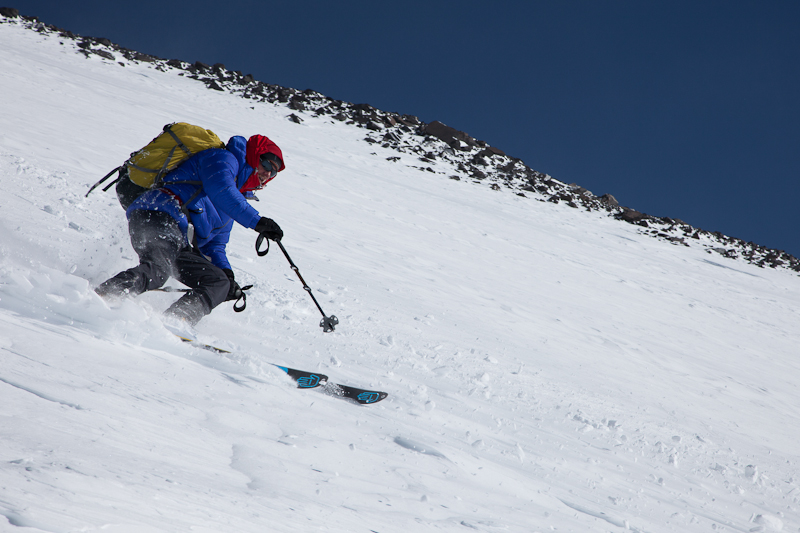
We reached the summit around 5:00PM, 7 hours after leaving 14 Camp. It was cold, windy, but relatively clear and amazingly beautiful. Probably the most beautiful part was that we still had the skis on our packs, and they were about to go on our feet! The most novel part about ski mountaineering is that it turns the worst part of climbing into the best part….the descent.

The snow was bulletproof wind-blasted nastiness from the top to about 19K’. It’s the kind of skiing that can make your fillings fall out. We would take three to four turns then have to catch our breath for half a minute. The skiing wasn’t great, but it sure beats walking. The best snow we found on the Phantom Wall, which rises above the 17K’ Camp. Turn after turn we cut up this slope. The air was getting thicker, the views were amazing, and my altimeter watch was having trouble keeping up with the speedy descent.

We stopped briefly at the 17K’ Camp to chat with friends, then walked down the West Buttress to the top of the fixed lines. There was more good snow to be found here, all the way back to our tents. We were tired, but grinning, as we crawled into the bags that night. We had just skied the West Buttress from 14 Camp in a little less than 12 hours.

The following two days we rested. I thought we would bounce back quicker than we did. The two nights after the summit push we packed our bags for the Cassin Ridge. Things were not looking that great, but we were going to be ready if they changed.

That night we set the alarm for 4AM to give us plenty of time to get started on the route. At 3:30AM what felt like a significant earthquake shook us awake. This was followed by serac fall. Scary. Then the wind picked up, and it started snowing. Things were not looking good.
In the mountains it is very easy to make a host of sound excuses not to put your body through more physical and mental exhaustion. I think we had a number of really good ones, which lead us to become part of the statistic stating that 90% of climbers who register to climb the Cassin Ridge never even get on it.  Next year I hope things are different.

Alaska 2012 was a great experience for us. Climbing the Harvard Route on Huntington was the highlight for me, and skiing for the summit of the highest point in North America was a close 2nd.